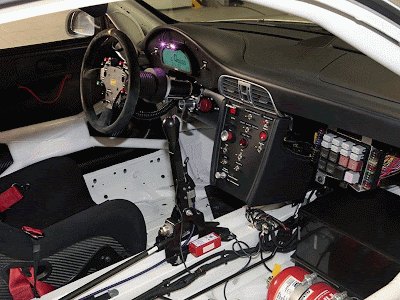
Porsche 911 Carrera, 2009


The very first sports car to bear the Porsche name was introduced to the world in June, 1948. Therefore, as the proud, independent Swabian automaker celebrates sixty years of sports car excellence, it is only fitting that it has a new Porsche 911 Carrera - for many the quintessential Porsche-to help mark the milestone.
The Porsche 911 Carrera Coupe and its higher-performance variant, the 911 Carrera S Coupe, are the most sophisticated, potent and environmentally friendly Porsche 911 Carrera models that Porsche has ever offered.
Despite their abundance of 21st century technologies, the 2009 911 Carrera Coupe and Carrera S Coupe clearly trace their engineering and aesthetic roots to the seminal Porsche. That original car evolved over fifteen years from the highly coveted 356 to the first 911 when, at the 1963 Frankfurt Motor Show, the ground-breaking 1964 911 Coupe debuted. As a testament to the genius of its design, after more than forty years of development and six generations of engineering improvements, the 911 Carreras still showcase a horizontally opposed, rear-mounted six-cylinder engine carried in a distinctive and instantly recognizable body.
Less Fuel In, More Power Out
Though the 2009 Porsche 911 Carrera Coupe and 911 Carrera S Coupe are each propelled by Porsche's familiar horizontally opposed, six-cylinder "boxer" engine, and despite the fact that both engines carry the same displacement designation as their immediate predecessors, both are substantially different than in 2008 model year.
In Porsche Parlance, "S" Means More
The 2009 Porsche 911 Carrera S Coupe, like its predecessor model, is powered by a larger, more potent version of the Porsche horizontally opposed six-cylinder than its non-S sibling. As with the 3.6-liter version in the Porsche 911 Carrera, the 3.8-liter engine benefits from less weight, a two-piece crankcase, improved intake and exhaust, and direct fuel injection. The fruits of these refinements are 385 horsepower at 6500 rpm and 310 lb.-ft. of torque at 4400 rpm. This is an increase of 30 hp and 15 lb.-ft. of torque while achieving a power output of 101.3 hp per liter, without the need for any form of supercharging.
With a boost in potency, the Porsche 911 Carrera S Coupe with manual gearbox runs to 60 mph (96 km/h) in only 4.5 seconds, on its way to a track-proven top speed of 188 mph (302 kmph).
The PDK driving-shifting automatic transmission shaves two-tenths of a second off the acceleration times of Porsche's most skilled test drivers. The 0 to 60 mph (96 km/h) run takes only 4.3 seconds. Track-proven top speed for the Carrera S Coupe with PDK is 186 mph (300 kmph).
Despite its awesome performance the nearly 400-hp Carrera S Coupe carries no gasguzzler stigma. And the added power and torque do nothing to diminish the engine's clean exhaust. Like the Carrera Coupe, the Porsche 911 Carrera S Coupe is certified as LEV-II.
It Starts With a Straight Shot
Both the 3.6-liter and 3.8-liter horizontally opposed, six-cylinder engines in the Porsche 911 Carrera Coupe and 911 Carrera S Coupe are substantially revamped from the similarly designated engines in last year's model range.
The engines still consist of a light alloy crankcase and cylinder heads, and have four valves per cylinder actuated by dual overhead camshafts. Now, for the first time in a Porsche sports car, the engines boast a direct fuel injection system (DFI), which works in concert with Porsche's VarioCam Plus valve lift and timing control.
By injecting fuel directly into the combustion chamber rather than in the intake port, DFI delivers myriad benefits. Since the fuel charge arrives closer to combustion than with port injection, throttle response is instantaneous, and the Porsche 911 Carrera driver feels a razor-like reaction to even the slightest movements of his right foot, whether accelerating or lifting from the throttle.
To take fullest advantage of the DFI's attributes, Porsche's engineers designed the combustion chamber and piston crown to maximize efficiency. Those refinements allowed the engineers to design both the 3.6-liter and 3.8-liter engines with a compression ratio of 12.5:1. This is up from 11.3:1 on the previous 3.6-liter and 11.8:1 of the former 3.8-liter. To ensure maximum efficiency and durability, the DFI injectors have been designed and manufactured to deal with working pressures of up to 1740 psi (120 bar) in the combustion chamber.
The fuel injector nozzle is between the two intake valves, spraying fuel directly into the incoming fresh air charge from both valves. This is clearly far more efficient than port injection which naturally leaves some unburned gasoline on the intake walls and valves. The incoming fuel charge further aids the combustion process by cooling the incoming air as it vaporizes, allowing more air to be drawn into the engine for a denser charge and permitting the higher compression ratios. Finally, the fuel and air are mixed more evenly and thoroughly when the fuel is injected directly into the air inside the combustion chamber.
DFI also reduces emissions since the engineers were able to reshape the piston crown to completely direct the fuel charge at the spark plug for thorough combustion. During start-up, the engine benefits from high-pressure stratification of the injected fuel. Then to quickly light off the catalysts, the DFI heats the exhaust rapidly through multiple injection. To increase the temperature of the exhaust gas to an even higher level, ignition timing is very late, further minimizing start-up emissions.
The system also employs multiple fuel injection during periods of combined high loads and engine speeds up to about 3500 rpm-as when the driver floors the throttle at slower speeds. During the multiple injection phases, the injectors split the fuel charge into several successive bursts during the piston's intake stroke. Otherwise, the fuel is injected in one phase during each intake stroke.
As with their predecessors, the new 3.6-liter and 3.8-liter engines are equipped with Porsche's VarioCam Plus intake valve timing and lift system. Porsche's engineers have refined the elements and operation of the VarioCam Plus to optimize the benefits of the DFI. The engineers re-aligned the profiles of both the intake and the exhaust camshafts. The diameter of the intake tappets has been reduced from 33 to 29.5 mm (1.30 - 1.15 in.) and the exhaust valve tappets are down from 33 to 24.2 mm (1.30 - 0.94 in.). This reduction in mass allowed the engineers to safely raise the engines' redlines, from the previous 7300 rpm to 7500 rpm.
Two, Two Camshafts in One
As with all Porsche engines, VarioCam Plus in the Porsche 911 Carrera and Carrera S Coupes adjusts intake valve lift and timing based on engine speed and load, and is under the umbrella of the engine's main electronic controller. Though the VarioCam Plus operates far too quickly for the driver to be aware of it, the results are obvious. The effect is that of an engine with two different intake camshaft profiles, one set up for smooth and efficient around-town driving, the other a high-performance camshaft designed for high-speed. Each of these two designs usually precludes the other and most cars have a compromise of the two. Porsche's VarioCam Plus removes the compromise and the driver benefits from the best of both driving worlds.
Valve timing is controlled via a vane cell adjuster which continuously varies the two intake camshafts positions relative to crankshaft. Valve lift is varied by a system utilizing two cup tappets, one resting in the other. These tappets are actuated by separate cam lobes of differing size. The engine control module directs oil pressure to the appropriate tappet based on engine speed and load parameters. When nonpressurized, the tappet moves under the camshaft lobe, but exerts no pressure on the valve, in effect free wheeling.
Different Size That's the Same
Finally, the various internal refinements to both the 3.6-liter and 3.8-liter engines result in slight changes to their displacements.
The 3.6-liter engine in the 2009 Carrera Coupe now has a 3.21 inch (81.5 mm) stroke, up by 1.3 mm over last year. Bore has been increased by 1.04 mm, and is now 3.82 inches (97 mm). The Porsche 911 Carrera S Coupe's 3.8-liter engine has a 3.05 inch (77.5 mm) stroke, down from the predecessor's 3.226 inches (82.8 mm). Bore has been increased by 3 mm to 4.02 inches (102 mm).
The results of these changes are that the 3.6-liter has an actual displacement of 3614 cc, or 18 cc more than before. The 3.8-liter actually sheds 24 cc and is now exactly 3800 cc.
Getting the Power Out
As before, both the Porsche 911 Carrera Coupe and Carrera S Coupe come equipped with a six-speed manual gearbox as standard. Commensurate with the increase in power over last year's models, the transmissions in both cars have been strengthened and refined.
Steel rather than brass synchronizing rings as well as thick shafts and wide gears provide strength, yet the transmission's weight is kept down by using extra-thin aluminum in the oil chamber walls. The transmission's internal architecture minimizes splash effect and flow losses, increasing the efficiency.
The gearbox uses wear-resistant carbon-coated synchromesh rings on first, second and third gears. In addition, first and second boast triple synchronizers. Third gear has double synchronizer rings and fourth through sixth gears uses a single ring. Taking advantage of the engines' increased output, the engineers altered Third gear, making it about 3 percent taller than before. This change improves around town fuel economy with no impact on performance or derivability.
These internal details mean the driver can shift more quickly and smoothly, since less force is needed and the linkage has shorter travel during gear changes.
In addition, the wear-compensating clutch which was formerly only found on the Carrera S, is now standard on the 3.6-liter model. As the friction face of the clutch wears, an adjustment ring in the pressure plate automatically compensates for the wear.
All 2009 911 Carrera models, regardless of transmission, also boast Start-Off Assistant as standard. This feature allows the driver to get moving again smoothly without rolling on a hill when starting from a stop. When the driver stops on an incline and leaves the transmission in gear, the Start-Off Assistant maintains brake pressure for about two seconds after the driver lifts his foot from the brake pedal. Then the system incrementally reduces brake pressure. As soon as the driver accelerates, brake pressure is fully released.
Multiple Clutches and Seven Speeds
For 2009, both the Porsche 911 Carrera and Carrera S Coupes can be equipped with the innovative and blazingly fast Porsche PDK transmission. The seven-speed, driver-shiftable automatic replaces the five-speed Tiptronic S as the optionally available transmission.
Though it was developed in the 1980s for the all-conquering Porsche 962 Group C racecar, thanks to recent advances in electronic control technology, this is the first time that the PDK is available in a street-faring sports car.
The new PDK (which comes from the German Porsche-Doppelkupplungsgetriebe or Porsche double-clutch transmission), like the Tiptronic S, allows the driver to shift up and down using either steering-wheel mounted paddles or the console-mounted lever. Or, if he'd rather, the driver can simply leave the PDK in automatic mode and allow it to operate totally on its own.
Stopping What Goes Fast
Inherent in the Porsche philosophy is that every Porsche must have braking power at least commensurate with its acceleration and top speed capabilities. Therefore, all are equipped with cross-drilled, internally vented four-wheel disc antilock brakes. And as the Porsche 911 Carrera and Carrera S Coupes have more power and speed than their immediate predecessors, they have more braking ability as well.
Keeping Up the Pressure
To ensure optimum safety, fuel economy and performance, Porsche engineers provide Carrera Coupe and Carrera S Coupe drivers with a safeguard against driving on a damaged or an underinflated tire. Both cars come with Porsche's Tire Pressure Control system (TPC). This system uses sensors at each wheel to constantly monitor inflation pressures. The system offers the driver two levels of warning, should it detect a problem.
If any tire shows a pressure drop of more than 2.9 psi but less than 5.8 psi from specifications, a text message in white lettering shows in the tachometer. This warning appears for 10 seconds each time the car is started. If pressure drops more than 5.8 psi, or if inflation pressure drops at a rate of 2.9 psi or more per minute, the warning becomes more urgent and is displayed in red text. This warning appears as soon as the respective values are exceeded, whether the vehicle is stationary or moving.
Sporty Handling = Accident Avoidance
Knowing full well that all vehicles are safest by avoiding an accident in the first place, Porsche's engineers understand that their cars' awesome dynamic abilities are as much of a safety feature as a performance attribute.
To ensure both dynamic safety and an exhilarating driving experience, Porsche's engineers have continued to refine and enhance their cars' suspensions. Building upon a wide stance, both the Porsche 911 Carrera and Carrera S Coupes sit on a large, secure footprint. Both cars have a 58.6 inch (1486 mm) front track. In back, the Carrera has a 60.4 inch (1534 mm) track. With its larger wheels and tires, the Carrera S has a rear track of 59.7 inches (1516 mm). Porsche's engineers then specified a lightweight and technologically advanced suspension system and a low center of gravity for optimum agility and driver confidence assuring stability.
Better Living through PASM
As noted, the Carrera S Coupe comes standard with the most recent version of Porsche Active Suspension Management (PASM). This system is optional on the Carrera Coupe. For the 2009 911 Carrera models, PASM suspension has refined springs and antiroll bars for even greater comfort. Porsche's engineers were able to accomplish this by fine-tuning the PASM control function, delivering a smoother ride on bad roads in both the Normal and Sport modes with no degradation in handling.
This electronically controlled suspension allows the driver to select either a Normal or Sport setting, depending on the driving situation and conditions. Besides allowing the choice of choice setups, PASM also lowers the car's ride height by about 0.4 inch (10 mm).
Variable-Ratio Steering
The Porsche 911 Carrera and Carrera S Coupes come with standard variable-ratio rack-andpinion steering. This both increases agility and stability at higher speed maneuvers and reduces steering effort at slow speeds.
When the steering wheel is turned within 30 degrees of center, the ratio is to provide a smooth and calm driving experience, even on rough surfaces. However, when the steering wheel angle exceeds 30 degrees, the ratio become more direct, reducing lock-to-lock from 2.98 to 2.62 turns. This gives the driver better control both on winding roads and in slow-speed parking maneuvers.
In addition to the variable ratio technology, the Porsche 911 Carrera Coupes have steering columns that tilt and telescope. The wheel can be adjusted by 1.57 inches (40 mm) in height and reach.
Classic Profile
The cars' profiles are highlighted by the new larger outside mirrors and by the newly designed wheels. The Porsche 911 Carrera's 18 inch alloy wheels have by five double spokes which are arranged so the each pair of spokes opens outward at the rim. The Carrera S has larger, 19 inch wheels which have five pairs of parallel spokes.
The Sound of Music
The Porsche 911 Carrera Coupes' standard audio system features AM/FM radio as well as the ability to play CDs, audio and video DVDs. The standard-equipment BOSE Surround Sound System features 5.1 Discreet Surround Format, and works with a gamut of audio formats: MP3, AAC, WMA, Dolby Digital, MLP, and DTS.
The PCM has an integral six-CD/DVD changer standard which supports the same formats as the single CD/DVD player. Plus, a new, optional universal audio interface connects the PCM to an external audio source such as an iPod or a USB stick. An optional TV tuner can receive uncoded television signals. While driving, only the TV audio plays; when parked the picture is shown on the PCM monitor.
Breath of Fresh Air
Automatic climate controls with air and pollen filtration are standard equipment. The controls for the heat, air conditioning and ventilation (HVAC) systems are integrated into the center console. Airflow through the HVAC system is optimized by large ducts and side vents.
Ample Storage Space
The cabins in the Porsche 911 Carrera Coupe and Carrera S Coupe offer the convenience of several storage locations. The cars' interiors have a load volume of 7.24 cu.-ft. (205 liters).
A large locking glove box provides nearly 400 cubic inches (6.5 liters) of room and has an integrated CD storage rack and a penholder. The center console includes more than 90 cubic inches (1.5 liters) of storage capacity. This compartment automatically locks with the Coupes' central locking system.
Cupholders are located just above the glove box and are hidden behind a folding cover. When released, the left cupholder emerges in front of the central air nozzle in the instrument panel while the right cupholder rests in front of the front passenger nozzle.
Critical Data
The five dials that comprise the instrument panel are positioned to provide outstanding readability. The faces of the dials are black in the 911 Carrera Coupe and have an aluminum-look finish in the Porsche 911 Carrera S Coupe.
Given the sporting soul of the Porsche 911 Carrera and Carrera S Coupes, the tachometer dominates the instrument cluster. The rev counter is the largest gauge and it is mounted in the center of the display. A digital speedometer within the tachometer's face beneath the rev counter allows the driver to check both vehicle and engine speed in a single glance.
The separate analog speedometer includes overall and trip odometers and is located just to the left of the tachometer. The gauge to the right of the tach includes coolant temperature and fuel indicators, as well as the clock. The oil temperature gauge is at the far left of the cluster with the oil pressure gauge at the far right.
Safe by Design
Thanks to the high- and ultra-high-strength steel as well as the sophisticated spotwelding and bonding techniques used during their manufacture, the Porsche 911 Carrera Coupe bodies are extremely torsionally rigid and flex resistant while still being lightweight.
Particular attention was paid in designing and engineering the junction of the A-pillars and the roof frame, as well as the safety structure involved in head-on and offset collisions, including the transition between the door and B-pillars. Forces in a collision can be transferred through the door, around the passenger compartment to the rear of the car.
A bulkhead crossbar at the front of the car is made from high-strength boron steel and special assembly processes were developed to minimize intrusion or into the foot well in an offset collision.
Six Airbags with POSIP
Occupants in the Porsche 911 Carrera and 911 Carrera S Coupes are protected, in the event of a collision by six airbags. There are two front-impact airbags; two front seatmounted, thorax protecting, side-impact airbags; and the two curtain-style, doormounted, side-impact airbags that are part of the Porsche Side Impact Protection (POSIP) system.
The frontal airbags are full-size, two-stage front units featuring an organic-based propellant. This propellant reduces the stored airbags' size and weight, and aids in their recyclability.
The front passenger seat features sensors that accommodate child safety seats. Should the sensors detect a child sitting in that seat, the airbag is defeated.
The POSIP boasts head airbags that deploy upward from their housings in the door windowsills. These airbags provide a flat cushion that inflates to nearly 500 cu.-in. (8 liters) and are designed to help protect the heads of the driver and front-seat passenger from broken glass and objects that might enter through the window, in the event of an accident.
Sport Chrono Package Plus
Both the Porsche 911 Carrera and Carrera S Coupes are available with the optional Sport Chrono Package Plus feature. Sport Chrono Package can be specified with either the manual gearbox or PDK transmission.
This enhancement package brings specific control maps to the engine management system and Porsche Stability Management (PSM), as well as to Porsche Active Suspension Management (PASM) and PDK on vehicles so equipped.
The revised engine control maps strongly favor performance over comfort and provide even quicker engine response, not only on deployment but also on release of the throttle. This helps the PDK shift even more aggressively.
Stability thresholds allow more lateral slip before the ABS and PSM intervene. On those cars with PASM, that system switches to its firmer setting to provide more agility in cornering. However, in some instances, such as on wet pavement, a softer suspension setting can be advantageous so the driver using Sport Chrono can press the PASM button to return to the normal damper settings.
The Sport Chrono package also includes a digital/analog stopwatch and lap-counting function.
The Porsche 911 Carrera Coupe and its higher-performance variant, the 911 Carrera S Coupe, are the most sophisticated, potent and environmentally friendly Porsche 911 Carrera models that Porsche has ever offered.
Despite their abundance of 21st century technologies, the 2009 911 Carrera Coupe and Carrera S Coupe clearly trace their engineering and aesthetic roots to the seminal Porsche. That original car evolved over fifteen years from the highly coveted 356 to the first 911 when, at the 1963 Frankfurt Motor Show, the ground-breaking 1964 911 Coupe debuted. As a testament to the genius of its design, after more than forty years of development and six generations of engineering improvements, the 911 Carreras still showcase a horizontally opposed, rear-mounted six-cylinder engine carried in a distinctive and instantly recognizable body.
Less Fuel In, More Power Out
Though the 2009 Porsche 911 Carrera Coupe and 911 Carrera S Coupe are each propelled by Porsche's familiar horizontally opposed, six-cylinder "boxer" engine, and despite the fact that both engines carry the same displacement designation as their immediate predecessors, both are substantially different than in 2008 model year.
In Porsche Parlance, "S" Means More
The 2009 Porsche 911 Carrera S Coupe, like its predecessor model, is powered by a larger, more potent version of the Porsche horizontally opposed six-cylinder than its non-S sibling. As with the 3.6-liter version in the Porsche 911 Carrera, the 3.8-liter engine benefits from less weight, a two-piece crankcase, improved intake and exhaust, and direct fuel injection. The fruits of these refinements are 385 horsepower at 6500 rpm and 310 lb.-ft. of torque at 4400 rpm. This is an increase of 30 hp and 15 lb.-ft. of torque while achieving a power output of 101.3 hp per liter, without the need for any form of supercharging.
With a boost in potency, the Porsche 911 Carrera S Coupe with manual gearbox runs to 60 mph (96 km/h) in only 4.5 seconds, on its way to a track-proven top speed of 188 mph (302 kmph).
The PDK driving-shifting automatic transmission shaves two-tenths of a second off the acceleration times of Porsche's most skilled test drivers. The 0 to 60 mph (96 km/h) run takes only 4.3 seconds. Track-proven top speed for the Carrera S Coupe with PDK is 186 mph (300 kmph).
Despite its awesome performance the nearly 400-hp Carrera S Coupe carries no gasguzzler stigma. And the added power and torque do nothing to diminish the engine's clean exhaust. Like the Carrera Coupe, the Porsche 911 Carrera S Coupe is certified as LEV-II.
It Starts With a Straight Shot
Both the 3.6-liter and 3.8-liter horizontally opposed, six-cylinder engines in the Porsche 911 Carrera Coupe and 911 Carrera S Coupe are substantially revamped from the similarly designated engines in last year's model range.
The engines still consist of a light alloy crankcase and cylinder heads, and have four valves per cylinder actuated by dual overhead camshafts. Now, for the first time in a Porsche sports car, the engines boast a direct fuel injection system (DFI), which works in concert with Porsche's VarioCam Plus valve lift and timing control.
By injecting fuel directly into the combustion chamber rather than in the intake port, DFI delivers myriad benefits. Since the fuel charge arrives closer to combustion than with port injection, throttle response is instantaneous, and the Porsche 911 Carrera driver feels a razor-like reaction to even the slightest movements of his right foot, whether accelerating or lifting from the throttle.
To take fullest advantage of the DFI's attributes, Porsche's engineers designed the combustion chamber and piston crown to maximize efficiency. Those refinements allowed the engineers to design both the 3.6-liter and 3.8-liter engines with a compression ratio of 12.5:1. This is up from 11.3:1 on the previous 3.6-liter and 11.8:1 of the former 3.8-liter. To ensure maximum efficiency and durability, the DFI injectors have been designed and manufactured to deal with working pressures of up to 1740 psi (120 bar) in the combustion chamber.
The fuel injector nozzle is between the two intake valves, spraying fuel directly into the incoming fresh air charge from both valves. This is clearly far more efficient than port injection which naturally leaves some unburned gasoline on the intake walls and valves. The incoming fuel charge further aids the combustion process by cooling the incoming air as it vaporizes, allowing more air to be drawn into the engine for a denser charge and permitting the higher compression ratios. Finally, the fuel and air are mixed more evenly and thoroughly when the fuel is injected directly into the air inside the combustion chamber.
DFI also reduces emissions since the engineers were able to reshape the piston crown to completely direct the fuel charge at the spark plug for thorough combustion. During start-up, the engine benefits from high-pressure stratification of the injected fuel. Then to quickly light off the catalysts, the DFI heats the exhaust rapidly through multiple injection. To increase the temperature of the exhaust gas to an even higher level, ignition timing is very late, further minimizing start-up emissions.
The system also employs multiple fuel injection during periods of combined high loads and engine speeds up to about 3500 rpm-as when the driver floors the throttle at slower speeds. During the multiple injection phases, the injectors split the fuel charge into several successive bursts during the piston's intake stroke. Otherwise, the fuel is injected in one phase during each intake stroke.
As with their predecessors, the new 3.6-liter and 3.8-liter engines are equipped with Porsche's VarioCam Plus intake valve timing and lift system. Porsche's engineers have refined the elements and operation of the VarioCam Plus to optimize the benefits of the DFI. The engineers re-aligned the profiles of both the intake and the exhaust camshafts. The diameter of the intake tappets has been reduced from 33 to 29.5 mm (1.30 - 1.15 in.) and the exhaust valve tappets are down from 33 to 24.2 mm (1.30 - 0.94 in.). This reduction in mass allowed the engineers to safely raise the engines' redlines, from the previous 7300 rpm to 7500 rpm.
Two, Two Camshafts in One
As with all Porsche engines, VarioCam Plus in the Porsche 911 Carrera and Carrera S Coupes adjusts intake valve lift and timing based on engine speed and load, and is under the umbrella of the engine's main electronic controller. Though the VarioCam Plus operates far too quickly for the driver to be aware of it, the results are obvious. The effect is that of an engine with two different intake camshaft profiles, one set up for smooth and efficient around-town driving, the other a high-performance camshaft designed for high-speed. Each of these two designs usually precludes the other and most cars have a compromise of the two. Porsche's VarioCam Plus removes the compromise and the driver benefits from the best of both driving worlds.
Valve timing is controlled via a vane cell adjuster which continuously varies the two intake camshafts positions relative to crankshaft. Valve lift is varied by a system utilizing two cup tappets, one resting in the other. These tappets are actuated by separate cam lobes of differing size. The engine control module directs oil pressure to the appropriate tappet based on engine speed and load parameters. When nonpressurized, the tappet moves under the camshaft lobe, but exerts no pressure on the valve, in effect free wheeling.
Different Size That's the Same
Finally, the various internal refinements to both the 3.6-liter and 3.8-liter engines result in slight changes to their displacements.
The 3.6-liter engine in the 2009 Carrera Coupe now has a 3.21 inch (81.5 mm) stroke, up by 1.3 mm over last year. Bore has been increased by 1.04 mm, and is now 3.82 inches (97 mm). The Porsche 911 Carrera S Coupe's 3.8-liter engine has a 3.05 inch (77.5 mm) stroke, down from the predecessor's 3.226 inches (82.8 mm). Bore has been increased by 3 mm to 4.02 inches (102 mm).
The results of these changes are that the 3.6-liter has an actual displacement of 3614 cc, or 18 cc more than before. The 3.8-liter actually sheds 24 cc and is now exactly 3800 cc.
Getting the Power Out
As before, both the Porsche 911 Carrera Coupe and Carrera S Coupe come equipped with a six-speed manual gearbox as standard. Commensurate with the increase in power over last year's models, the transmissions in both cars have been strengthened and refined.
Steel rather than brass synchronizing rings as well as thick shafts and wide gears provide strength, yet the transmission's weight is kept down by using extra-thin aluminum in the oil chamber walls. The transmission's internal architecture minimizes splash effect and flow losses, increasing the efficiency.
The gearbox uses wear-resistant carbon-coated synchromesh rings on first, second and third gears. In addition, first and second boast triple synchronizers. Third gear has double synchronizer rings and fourth through sixth gears uses a single ring. Taking advantage of the engines' increased output, the engineers altered Third gear, making it about 3 percent taller than before. This change improves around town fuel economy with no impact on performance or derivability.
These internal details mean the driver can shift more quickly and smoothly, since less force is needed and the linkage has shorter travel during gear changes.
In addition, the wear-compensating clutch which was formerly only found on the Carrera S, is now standard on the 3.6-liter model. As the friction face of the clutch wears, an adjustment ring in the pressure plate automatically compensates for the wear.
All 2009 911 Carrera models, regardless of transmission, also boast Start-Off Assistant as standard. This feature allows the driver to get moving again smoothly without rolling on a hill when starting from a stop. When the driver stops on an incline and leaves the transmission in gear, the Start-Off Assistant maintains brake pressure for about two seconds after the driver lifts his foot from the brake pedal. Then the system incrementally reduces brake pressure. As soon as the driver accelerates, brake pressure is fully released.
Multiple Clutches and Seven Speeds
For 2009, both the Porsche 911 Carrera and Carrera S Coupes can be equipped with the innovative and blazingly fast Porsche PDK transmission. The seven-speed, driver-shiftable automatic replaces the five-speed Tiptronic S as the optionally available transmission.
Though it was developed in the 1980s for the all-conquering Porsche 962 Group C racecar, thanks to recent advances in electronic control technology, this is the first time that the PDK is available in a street-faring sports car.
The new PDK (which comes from the German Porsche-Doppelkupplungsgetriebe or Porsche double-clutch transmission), like the Tiptronic S, allows the driver to shift up and down using either steering-wheel mounted paddles or the console-mounted lever. Or, if he'd rather, the driver can simply leave the PDK in automatic mode and allow it to operate totally on its own.
Stopping What Goes Fast
Inherent in the Porsche philosophy is that every Porsche must have braking power at least commensurate with its acceleration and top speed capabilities. Therefore, all are equipped with cross-drilled, internally vented four-wheel disc antilock brakes. And as the Porsche 911 Carrera and Carrera S Coupes have more power and speed than their immediate predecessors, they have more braking ability as well.
Keeping Up the Pressure
To ensure optimum safety, fuel economy and performance, Porsche engineers provide Carrera Coupe and Carrera S Coupe drivers with a safeguard against driving on a damaged or an underinflated tire. Both cars come with Porsche's Tire Pressure Control system (TPC). This system uses sensors at each wheel to constantly monitor inflation pressures. The system offers the driver two levels of warning, should it detect a problem.
If any tire shows a pressure drop of more than 2.9 psi but less than 5.8 psi from specifications, a text message in white lettering shows in the tachometer. This warning appears for 10 seconds each time the car is started. If pressure drops more than 5.8 psi, or if inflation pressure drops at a rate of 2.9 psi or more per minute, the warning becomes more urgent and is displayed in red text. This warning appears as soon as the respective values are exceeded, whether the vehicle is stationary or moving.
Sporty Handling = Accident Avoidance
Knowing full well that all vehicles are safest by avoiding an accident in the first place, Porsche's engineers understand that their cars' awesome dynamic abilities are as much of a safety feature as a performance attribute.
To ensure both dynamic safety and an exhilarating driving experience, Porsche's engineers have continued to refine and enhance their cars' suspensions. Building upon a wide stance, both the Porsche 911 Carrera and Carrera S Coupes sit on a large, secure footprint. Both cars have a 58.6 inch (1486 mm) front track. In back, the Carrera has a 60.4 inch (1534 mm) track. With its larger wheels and tires, the Carrera S has a rear track of 59.7 inches (1516 mm). Porsche's engineers then specified a lightweight and technologically advanced suspension system and a low center of gravity for optimum agility and driver confidence assuring stability.
Better Living through PASM
As noted, the Carrera S Coupe comes standard with the most recent version of Porsche Active Suspension Management (PASM). This system is optional on the Carrera Coupe. For the 2009 911 Carrera models, PASM suspension has refined springs and antiroll bars for even greater comfort. Porsche's engineers were able to accomplish this by fine-tuning the PASM control function, delivering a smoother ride on bad roads in both the Normal and Sport modes with no degradation in handling.
This electronically controlled suspension allows the driver to select either a Normal or Sport setting, depending on the driving situation and conditions. Besides allowing the choice of choice setups, PASM also lowers the car's ride height by about 0.4 inch (10 mm).
Variable-Ratio Steering
The Porsche 911 Carrera and Carrera S Coupes come with standard variable-ratio rack-andpinion steering. This both increases agility and stability at higher speed maneuvers and reduces steering effort at slow speeds.
When the steering wheel is turned within 30 degrees of center, the ratio is to provide a smooth and calm driving experience, even on rough surfaces. However, when the steering wheel angle exceeds 30 degrees, the ratio become more direct, reducing lock-to-lock from 2.98 to 2.62 turns. This gives the driver better control both on winding roads and in slow-speed parking maneuvers.
In addition to the variable ratio technology, the Porsche 911 Carrera Coupes have steering columns that tilt and telescope. The wheel can be adjusted by 1.57 inches (40 mm) in height and reach.
Classic Profile
The cars' profiles are highlighted by the new larger outside mirrors and by the newly designed wheels. The Porsche 911 Carrera's 18 inch alloy wheels have by five double spokes which are arranged so the each pair of spokes opens outward at the rim. The Carrera S has larger, 19 inch wheels which have five pairs of parallel spokes.
The Sound of Music
The Porsche 911 Carrera Coupes' standard audio system features AM/FM radio as well as the ability to play CDs, audio and video DVDs. The standard-equipment BOSE Surround Sound System features 5.1 Discreet Surround Format, and works with a gamut of audio formats: MP3, AAC, WMA, Dolby Digital, MLP, and DTS.
The PCM has an integral six-CD/DVD changer standard which supports the same formats as the single CD/DVD player. Plus, a new, optional universal audio interface connects the PCM to an external audio source such as an iPod or a USB stick. An optional TV tuner can receive uncoded television signals. While driving, only the TV audio plays; when parked the picture is shown on the PCM monitor.
Breath of Fresh Air
Automatic climate controls with air and pollen filtration are standard equipment. The controls for the heat, air conditioning and ventilation (HVAC) systems are integrated into the center console. Airflow through the HVAC system is optimized by large ducts and side vents.
Ample Storage Space
The cabins in the Porsche 911 Carrera Coupe and Carrera S Coupe offer the convenience of several storage locations. The cars' interiors have a load volume of 7.24 cu.-ft. (205 liters).
A large locking glove box provides nearly 400 cubic inches (6.5 liters) of room and has an integrated CD storage rack and a penholder. The center console includes more than 90 cubic inches (1.5 liters) of storage capacity. This compartment automatically locks with the Coupes' central locking system.
Cupholders are located just above the glove box and are hidden behind a folding cover. When released, the left cupholder emerges in front of the central air nozzle in the instrument panel while the right cupholder rests in front of the front passenger nozzle.
Critical Data
The five dials that comprise the instrument panel are positioned to provide outstanding readability. The faces of the dials are black in the 911 Carrera Coupe and have an aluminum-look finish in the Porsche 911 Carrera S Coupe.
Given the sporting soul of the Porsche 911 Carrera and Carrera S Coupes, the tachometer dominates the instrument cluster. The rev counter is the largest gauge and it is mounted in the center of the display. A digital speedometer within the tachometer's face beneath the rev counter allows the driver to check both vehicle and engine speed in a single glance.
The separate analog speedometer includes overall and trip odometers and is located just to the left of the tachometer. The gauge to the right of the tach includes coolant temperature and fuel indicators, as well as the clock. The oil temperature gauge is at the far left of the cluster with the oil pressure gauge at the far right.
Safe by Design
Thanks to the high- and ultra-high-strength steel as well as the sophisticated spotwelding and bonding techniques used during their manufacture, the Porsche 911 Carrera Coupe bodies are extremely torsionally rigid and flex resistant while still being lightweight.
Particular attention was paid in designing and engineering the junction of the A-pillars and the roof frame, as well as the safety structure involved in head-on and offset collisions, including the transition between the door and B-pillars. Forces in a collision can be transferred through the door, around the passenger compartment to the rear of the car.
A bulkhead crossbar at the front of the car is made from high-strength boron steel and special assembly processes were developed to minimize intrusion or into the foot well in an offset collision.
Six Airbags with POSIP
Occupants in the Porsche 911 Carrera and 911 Carrera S Coupes are protected, in the event of a collision by six airbags. There are two front-impact airbags; two front seatmounted, thorax protecting, side-impact airbags; and the two curtain-style, doormounted, side-impact airbags that are part of the Porsche Side Impact Protection (POSIP) system.
The frontal airbags are full-size, two-stage front units featuring an organic-based propellant. This propellant reduces the stored airbags' size and weight, and aids in their recyclability.
The front passenger seat features sensors that accommodate child safety seats. Should the sensors detect a child sitting in that seat, the airbag is defeated.
The POSIP boasts head airbags that deploy upward from their housings in the door windowsills. These airbags provide a flat cushion that inflates to nearly 500 cu.-in. (8 liters) and are designed to help protect the heads of the driver and front-seat passenger from broken glass and objects that might enter through the window, in the event of an accident.
Sport Chrono Package Plus
Both the Porsche 911 Carrera and Carrera S Coupes are available with the optional Sport Chrono Package Plus feature. Sport Chrono Package can be specified with either the manual gearbox or PDK transmission.
This enhancement package brings specific control maps to the engine management system and Porsche Stability Management (PSM), as well as to Porsche Active Suspension Management (PASM) and PDK on vehicles so equipped.
The revised engine control maps strongly favor performance over comfort and provide even quicker engine response, not only on deployment but also on release of the throttle. This helps the PDK shift even more aggressively.
Stability thresholds allow more lateral slip before the ABS and PSM intervene. On those cars with PASM, that system switches to its firmer setting to provide more agility in cornering. However, in some instances, such as on wet pavement, a softer suspension setting can be advantageous so the driver using Sport Chrono can press the PASM button to return to the normal damper settings.
The Sport Chrono package also includes a digital/analog stopwatch and lap-counting function.